
In 2007, Mariam Naficy founded Minted. The idea was to sell stationery – greeting cards, wedding invitations, etc – online. Naficy had achieved e-commerce success during the Dot.com boom, founding Eve.com, an online cosmetics retailer that sold for $110 million (Shontell, 2011). However, it soon became clear that times had changed and simply bringing an offline product online was no longer enough. In response, Minted harnessed a new idea – crowdsourcing – to pivot to a different, more innovative business model.
How Does It Work?
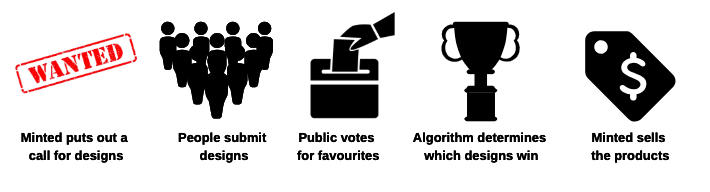
Minted announces an open competition calling for the public to submit designs for a particular category of product – Save the Date cards, say. When the competition closes, the submitted designs are posted online for people to vote for their favourite. These votes are then fed into an algorithm which weights the votes based on data about which demographics of voter are best able to predict sales of that type of design (Carson, 2019). Based on this weighting, the algorithm selects winners, whose designs are then sold on Minted.com.
Minted is valued at over $700 million, with annual revenues increasing at 39% year-on-year (Carson, 2019). The secret behind the startup’s success lies in its innovative business model that gives Minted several advantages over its competitors.
1. Costs are Low
Because Minted crowdsources designs, the company’s costs are incredibly low. They don’t have to hire in-house designers and no longer expend money and energy on signing existing brands to sell on their platform. They also don’t have to pay designers unless their designs are selected – this is different from working with freelancers, who would charge for a project regardless of whether their work is used. On Minted, winning designers get paid a prize fee of between $100-$3000 and earn a 6% commission on net sales of their product (“About us | Minted”, 2019). This ends up far cheaper for Minted than hiring in-house designers, working with freelancers, or signing brands. Mariam Naficy further explains how crowdsourcing fuels Minted’s business in the video below.
2. Products are Validated by Design

Thanks to the clever pairing of crowdsourced voting and data-powered algorithm, Minted’s products are validated before a penny is spent on development. Minted has a near-guarantee that every new product they release is going to sell well. With estimates of new product failures at over 80% (Kocina, 2017), this is a huge advantage. Whereas traditional greeting card companies may have to go with their gut on new product launches or invest thousands of dollars into market research, Minted has the eyes and ears of thousands of consumers at their disposal, every day, completely free.
3. No Inventory is Wasted
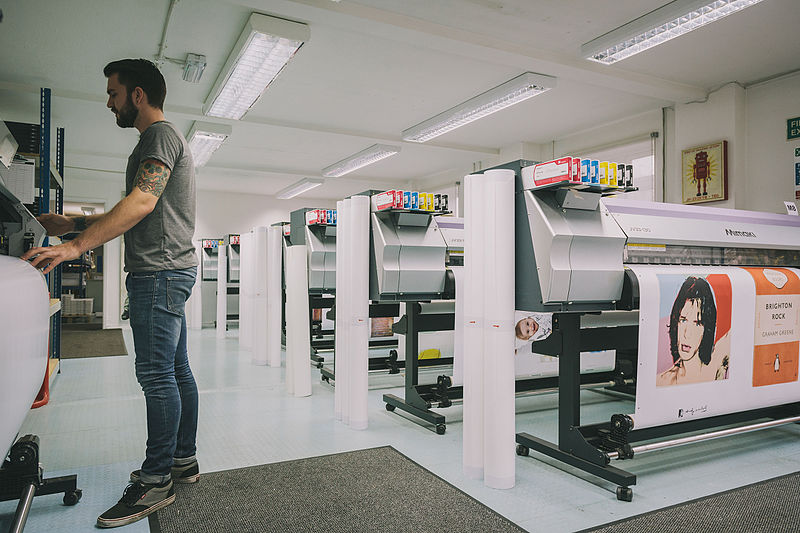
Finally, the third distinguishing feature of Minted’s business model is the fact that products are produced only when they are ordered. Because the majority of products on the site are personalisable, they are printed only when somebody pays for them. Although this presents logistical challenges in delivering quick turnarounds, this model ensures that nearly no inventory is wasted. This means that even if a product makes it into production but doesn’t sell well, Minted loses nothing but the designer’s prize fee, because no stock will have been produced.
Is Minted’s Business Model Sustainable?
The empire may or may not eventually fall, but for now, Minted has built a highly profitable enterprise based on a clever digital business model. It has, in fact, proved so successful that Minted is no longer just a stationery company: it now applies the same model to wall art and home decor, and recently raised $208 million in Series E funding for expansion into other markets (Clark, 2018).
Of course, a potential problem with running a business based on crowdsourcing is the risk of losing the crowd. Minted is dependent on its online community in every stage of its business model. If Minted’s users were to stop entering their competitions and voting for their favourite designs, the company would be in trouble. How likely is that to happen? Well, Minted has thousands of engaged members who love the service and feel it enables them to pursue their creative hobbies more seriously than would otherwise be possible (Birstengel, 2018). However, some designers are not huge fans.
In an article on her blog, designer Kiffanie Stahle discouraged artists from entering Minted competitions, claiming that Minted’s terms and conditions are unfair in taking away artists’ copyright of their own designs (Stahle, 2018). Many believe that the entire concept of crowdsourcing is unethical because it involves people doing work for for-profit organisations for free or at a fraction of the price the company would otherwise have to pay (Schmidt, 2013). If this way of looking at crowdsourced design catches on with its community, Minted’s business will be in danger of collapse. The video below further discusses some of the ethical concerns associated with crowdsourcing.
The empire may or may not eventually fall, but for now, Minted has built a highly profitable enterprise based on a clever digital business model. It has, in fact, proved so successful that Minted is no longer just a stationery company: it now applies the same model to wall art and home decor, and recently raised $208 million in Series E funding for expansion into other markets (Clark, 2018).
Reference List
About Us | Minted. (2019). Retrieved from https://www.minted.com/about-us
Birnstengel, G. (2018). Minted Online Community Helps Older Artists Sell — And Find Buddies. Retrieved from https://www.forbes.com/sites/nextavenue/2018/06/22/minted-online-community-helps-older-artists-sell-and-find-buddies/#1521eda4327b
Carson, B. (2019). A Dot-Com Era Survivor Is Back With Minted, A $700M Stationery Startup For The Instagram Generation. Retrieved from https://www.forbes.com/sites/bizcarson/2019/01/23/a-dot-com-era-survivor-is-back-with-minted-a-700m-stationery-startup-for-the-instagram-generation/#4816029146f8
Dawson, R. (2012). The Ethics of Crowdsourcing. Retrieved from https://www.youtube.com/watch?v=FLU0T6BZri0
Fox Business. (2015). How Minted curates design through crowdsourcing [Video]. Retrieved from https://www.youtube.com/watch?v=f4zkMGy9qCk
Kocina, L. (2017). What percentage of new products fail and why?. Retrieved from https://www.publicity.com/marketsmart-newsletters/percentage-new-products-fail/
Morgans, D. (2013). Print on Demand machines at King and McGaw warehouse in Newhaven [Image]. Retrieved from https://commons.wikimedia.org/wiki/File:Kingandmcgaw-print-on-demand-machines.jpg
Naficy, M. (2015, November 25). How Minted’s CEO Kept Her Paper Design Company From Folding (L. Schiller, Interviewer) Fortune. Retrieved from http://www.fortune.com
Naficy, M. (2018). Minted: Mariam Naficy [Radio].
Shontell, A. (2011). In 2000, 28-Year-Old Mariam Naficy Sold Her Startup For $110 Million — Will History Repeat Itself?. Retrieved from https://www.businessinsider.com/minted-2011-11?r=US&IR=T
Stahle, K. (2018). What did you agree to when you entered a Minted challenge?. Retrieved from https://theartistsjd.com/minted-challenge-tos/
What is Crowdsourcing?. (2010). [Video]. Retrieved from https://www.youtube.com/watch?v=Buyub6vIG3Q

 Digital Business Digest

Hi Emilie, really enjoyed reading this blog, it focuses on the “crowdsourcing” business model that Minted uses and gives a really clear and well-structured explanation. I’m just curious about what you said that “Minted has a near-guarantee that every new product they release is going to sell well.” How do you think that happens? Because generally, even if customers vote for a design, it doesn’t mean that they are going to pay for it. Besides, if a company uses totally different designs for its product lines, will it still have a strong and coherent image? I’ve browsed the Minted official website, everything looks so harmonious together, how did they do that? And finally, do you think if the company don’t only produce the most voted design, but allow customers to print any single design they like, will that be more efficient? Sorry for bringing up so many questions, this article just inspired me so much! Thank you!
LikeLike
Hi Shiyan, thanks for your comment! I agree with you, voting alone isn’t necessarily a guarantee that people will buy – however, I think large number of votes can serve well an indication of public taste. Also, this is where their algorithm comes in – they can use past data to weight votes according to who they think is best able to predict sales – e.g. they can say that we know Mid-Western housewives are best at predicting sales of children’s birthday cards. Even without the algorithm though, it’s still a hell of a lot better than just showing it to a focus group! Regarding the image, that’s a good point – I think that although the designs are different, Minted still gets to choose how they are presented. For example, it can insert placeholder photos with the appropriate ambience. They can also choose for themselves what goes on the front page and so on. I think that helps. And to your last question, I guess you could print any design customers want, but I think the value that Minted provides lies in the unique designs on their website – they are different from any others you might find Hallmark producing, but they are still great-looking and professional. I’m not sure that everybody wants to spend a ton of time and effort designing every card they send out, and the results, if they did, would probably not all be that great! If people do want a totally unique design, there are custom designers that they can go to who will create that for you – at a price, of course 🙂
LikeLiked by 1 person
I am really pleased to see a woman at the head of this startup, with an amazing rise of 39% which is huge for a company. We can definitely say that Minted’s digital business model has contributed to its success. By using an online platform like crowdsourcing, the company wins many advantages: no inventory lost in terms of raw materials like paper and then becomes more sustainable. Regarding, the design, I find that the way Minted selects their designers, is positive for one thing: it allows designers from all around the world to earn money. However, I agree with the fact that it is unfair for designers who spend hours of working on a project for nothing and they will probably never be selected among thousands of designers. Last but not least, Minted should not count only on the crowd, as we all know that trends are changing so fast.
LikeLike
Thanks for your comment, Clara 🙂 Yes, I agree, I think it’s awesome to see Mariam Naficy achieve such great success! She seems to be a very clever and inspirational person.
LikeLike
Cleaver business model! Thank you for sharing this. There is so much talented people, using crowdsourcing to pull in those designer is smart! Not just they don’t waste a time to find a designer, but like you mention they can save money as they don’t have to pay for unwanted design. I think it is also save time and human resource in the process. They are no long need to hire some one to select the product peace by peace, but the world can do that for them. It is like combining the process of market research at a low cost, less work and time. However, I wonder how much of the voter becomes a real customer? And if the hub of voter is growing or not and what are the benefit of voting because I feel that if there is no benefit they will stop vote it someday. And if the hub is not growing and and those voter had already bought stuff from the company, the market may saturated and the forecast may not as accurate as today. So company may need to find a way to grow the list. For the existing one, maybe offer them a new product line? I think they may extend the business far beyond the wall and home decors. One thing I think it would be so great if they can develop an application that their customer could use AR to picture how a particular design would fit their home!
LikeLike
Thanks for your comment! Yes, I don’t know if the voter pool is growing but as far as I know people vote! I think a lot of designers go through other people’s designs for inspiration, voting as they go, so that’s one source. I don’t know how many voters become real customers, but at the end of the day I think that with their algorithm in place, it doesn’t matter because they can tell who’s best at predicting sales anyway!
LikeLike